Sunday, October 13, 2013

The Knights of Labor

I)                 Union building period – in the years following the Great Upheaval, working people sought out organizations that they felt could help them cope with the developing capitalist system

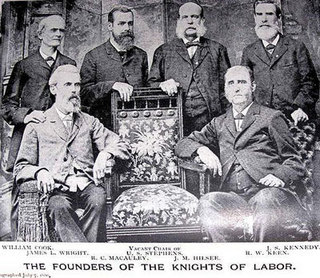
A)    Origins of the Knights of Labor – founded in Philadelphia in 1869 as a union of tailors, the organization remained small and secretive until the former mayor of Scranton, PA was elected to the position of Grand Master Workman by the name of Terrence V. Powderly.

1) Uriah Stephens--became the 1st Grand Master Workman, and it was his vision that largely shaped the organization. Stephens, who had to abandon his studies to become a minister after the Panic of 1837, and instead became an apprentice tailor. Stephens' religious background informed his vision about the universality of labor--and this influenced the vision of the organization from its inception to its demise.

2) Secrecy and Ritual--during the early years of the organization, membership was a tightly kept secret. Part of the reason for this secrecy was due to the hostility of employers to any labor organization during this time period. But this secrecy also added to the allure of the organizations, as well, with its secret handshake, mystical ceremonies, and special symbols. This secrecy inhibited enlarging the organization greatly, however; it wasn't until 1872 (3 years after its founding in 1869) that a second chapter was founded, and not until 1874 that the organization was established outside of the greater Philadelphia area.

3) Goals and Program--the ultimate goal of the Knights of Labor was to reform--or, better yet, transcend--the emerging capitalist economic system. To accomplish this, the Oder welcomed all "producers"; meaning everyone but doctors, lawyers, bankers, gamblers, and liquor dealers.

4)      Organization by location – rather than organize workers by craft, the K of L organized workers by location, by city and/or neighborhood. Eventually they succumbed to demands by skilled workers, however, and in addition also organized workers by job skill.

a) General Assembly--the ultimate authority in the K of L, the General Assembly met once a year, and was made up of representatives from the various District Assemblies.

b) District Assemblies--made up from a number of local assemblies.

c) Local Assemblies (LA)--local assemblies generally were made up of two different kinds of organizations: mixed assemblies, which consisted of workers from a variety of different trades; and trade assemblies, where all members belonged to a specific trade. This make-up was largely determined by local conditions and the size or the local working population; cities with larger populations tended to have LAs more oriented toward craft differences, while LAs in smaller cities tended to have greater diversity within their ranks.

5)      Bi-racial organization – the K of L avoided being trapped by the conundrum of racial differences between black and whites, and organized black workers (and often integrated them within District Assemblies, which was the base level in the organization).

(a)    This bit of racial understanding did not extend to the Chinese workers, however, who were excluded from membership along with liquor dealers, cardsharps, lawyers, and other such scum. This policy may have been influenced by the small number of Chinese workers, their geographic concentration, and the expectation that Chinese immigration (and labor competition) could be closed off by the Chinese Exclusion Act (first passed in 1882, renewed in 1892, and made permanent--until 1943--in 1902).

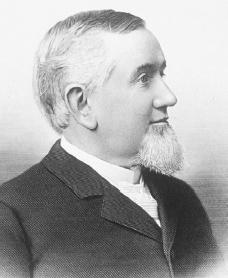
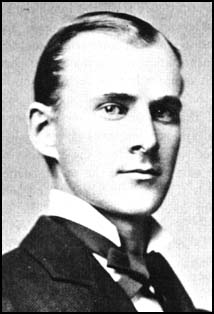
B) Terence Powderly--When Uriah Stephens retired from the Order in 1878 to run for Congress on the Greenback Labor Party ticket, Terence V. Powderly was chosen to be his successor in the position of Grand Master Workman.

1) Early life--Powderly was born in Carbondale, Pennsylvania in 1849, the son of Irish Catholic parents who emigrated to the United States in the 1820s. Powderly worked as a young boy as a switch tender in a local rail yard, but at the age of 17 he left to become an apprentice machinst.

2) Working life--after serving his apprenticeship, Powderly became a member of the International Union of Machinists and Blacksmiths, and by 1874 he had also become a member of the Knights of Labor.

3) Political life--at the same time Powderly was rising through the ranks of the Knights of Labor, he was also becoming active in local politics; participating first in the activities of the Greenback-Labor Party, and then being elected mayor of Scranton, Pennsylvania in 1878. Powderly held that office until 1884, serving simultaneously as mayor and Grand Master Workman until 1884.

4) Personal life--Powderly was of a slender build, and of less than average height. A convinced teetotaler, he had little patience for those who enjoyed drinking--which meant that he had little time for the conviviality of the tavern where much union recruitment took place. This undoubtedly had some adverse effect upon the view that K of L members developed of Powderly.

5) Contribution to the Knights of Labor--although Powderly presided over the great expansion in membership of the K of L, Powderly was not dedicated to the movement in the same way as, say, William Sylvis, but he nevertheless worked very hard to build the organization.

6) Influence with the Roman Catholic Church--Powderly was himself a devout Roman Catholic. The Church was very wary of secret organizations--particularly those that modeled themselves after the Masonic Order, and generally forbid members from joining these types of organizations on pain of excommunication. Powderly's handling of the situation helped persuade Cardinal Gibbon to intercede with the Pope on the Knight's behalf, and permitted the Knights to make inroads with Roman Catholic workers.

7) Cooperation--Powderly's core belief that cooperation between management and labor would permit the two sides to transcend their differences, and also to set up consumer and producer cooperatives, were all producers would receive a fair price for the fruits of their labor.

a) One of the 135 cooperatives established nationwide was started in Toledo by local reed workers.

C) The Rise of the Knights of Labor--both the rise and ultimately the decline of the K of L was in part a result of economic and social circumstances beyond its control
1)      Organizing success – although the official position of the organization opposed strikes, the K of L had great success organizing workers as a result of successful strikes that the union became involved with. As the economic recovery of the late 1870s and early 1880s began to lose steam, employers began to attempt to impose wage cuts on workers as they had in the wake of the 1873 Depression. Workers, again, attempted to resist these wage cuts, and many walked out on strike. While most of these strike were defeated, workers organized by the Knights of Labor were largely successful in forcing employers to rescind these wage cuts.

(a)    Southwestern System strike (1884) – workers of Jay Gould’s Southwestern System went on strike in response to Gould’s insistence that they take a pay cut; the success of the strike almost double the membership of the organization, to approximately 110,000 members, by 1886--with a much larger population of workers sympathetic to the K of L, but who were not official members (perhaps as many as 500,000).

(b) Southwestern System strike (1886)--workers in the Southwestern System, feeling (perhaps over)confident because of past success, went out on strike against Gould's rail system again in 1886. This time, Gould was better prepared, and successfully prevailed upon state governments to use the militia to break the strike in a variety of states. As a result, the strike was defeated, and discouraged rail workers began falling away from the organization


2) Organizing failure--the failure of the 1886 Southwestern System strike (in the workers' view, caused by Powderly's failure to support them in their efforts), coupled with the defeat of Knights-organized packinghouse workers that same year in Chicago, led to a precipitous decline in membership, as members left as quickly in 1886 has they had joined in 1885. The Knights of Labor lost most of its influence as a result, and it became little more than a paper organization.

D. Who were the Knights of Labor--and Why Did They Join?

1. People of diverse opinions were members (at one time), from Samuel Gompers (first president of the American Federation of Labor, to Albert Parsons (one of the accused Haymarket Anarchists).

2. United by their opposition to the wage system--or the "slave wage" system, as they saw it. This is difficult for we moderns to understand, I think, because we have become so inured to it; how would one survive on the sweat of ones' face (to borrow from the biblical term) if not from wages? For Knights, that answer was to transform society through the organization, to build workers' cooperatives, and to find other means of exchange than cash.

Sunday, October 06, 2013

The Labor Problem of the 19th Century


I. 1877—The Great Upheaval

A. Railroads—the “engine” of economic growth by the mid-19th century, but also caused a great deal of disruption in the neighborhoods that the trains passed through, particularly in this time before the grade the railroad tracks ran on was elevated.

1. Injuries to children—in these neighborhoods, children were regularly injured or killed because they were hit by a train.

2. Injuries to railroad workers—working on a railroad was very dangerous work, and workers were regularly maimed or killed, particularly working in the rail yard, coupling and uncoupling rail cars.

3. Watered stock—in this period of rapid expansion, railroad companies often sold more stock than they had assets or profits to cover; or the board of directors might issue themselves more stock to stave off (or profit from) a merger with another company. This was known as “watering” the stock, and was a huge problem for investors not on the board of directors.

4. Depression of 1873—caused in large part by the bankruptcy of Jay Cooke & Company, a Philadelphia investment bank financing the initial construction of the Northern Pacific Railroad. This depression lasted until 1879.

5. Cost-cutting—then, like today, companies were more concerned with the bottom line than with the well-being of their workers, and immediately began cutting wages and jobs—through thousands of people out of work

B. The Great Upheaval—the continuation of the depression meant that businesses continued to cut wages and workers, particularly in the railroad industry.

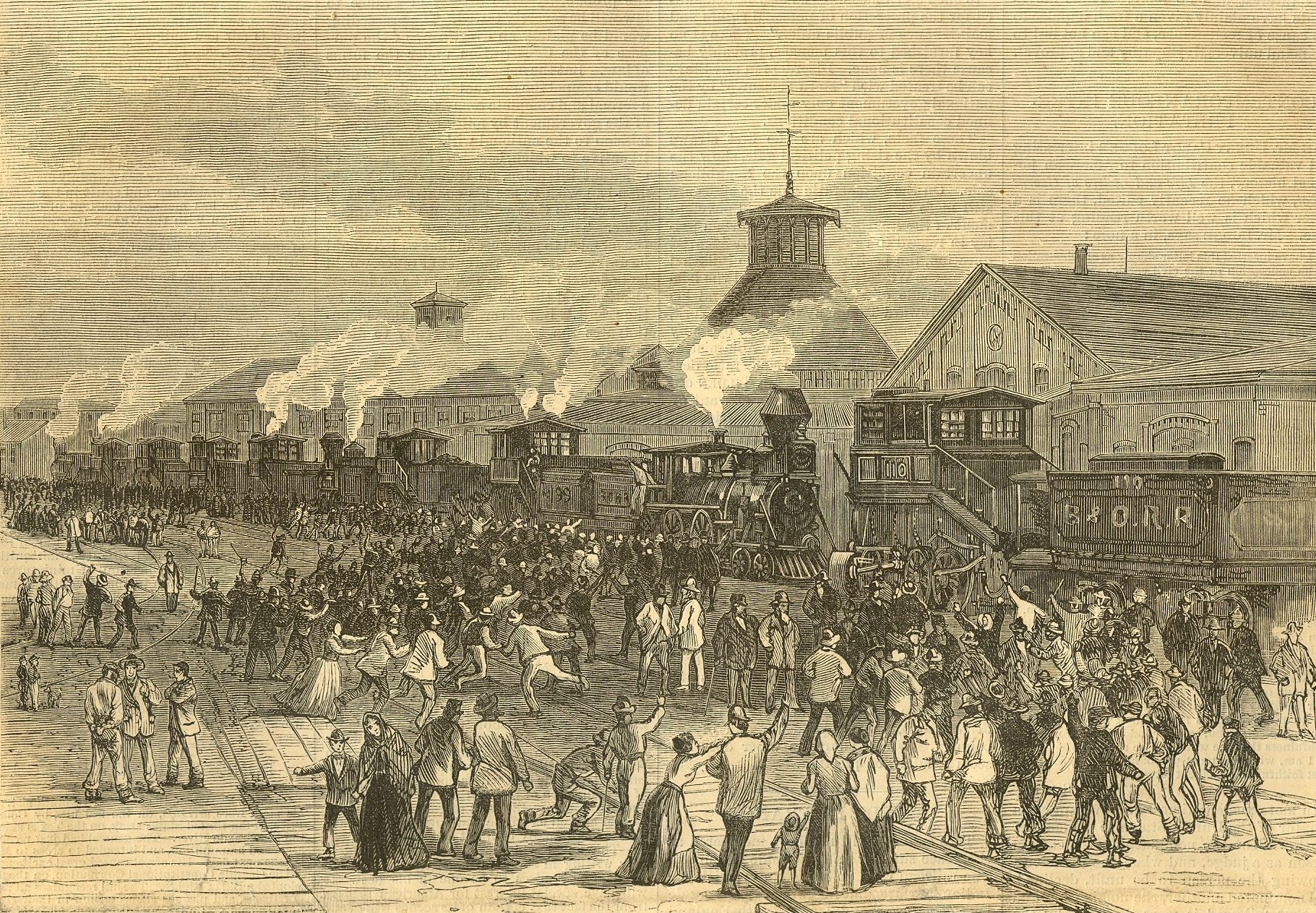
1. Martinsburg, WVa—a critical junction of the Baltimore and Ohio Railroad. Workers there decided to strike to attempt to force the company to rescind yet another wage cut in the summer of 1877. Workers prevented trains from passing through Martinsburg, despite the effort of the governor of West Virginia to mobilize the state militia. Workers also used their knowledge of and access to communication technology to workers around the rest of the country.

2. Pittsburgh—inspired by news of events in Martinsburg, and facing similar wage cuts, railroad workers in Pittsburgh went on strike against the Pennsylvania Railroad. When the militia was called up, they chose to bring troops from Philadelphia, were the Pennsylvania Railroad was headquartered. The arrival of this force of “outsiders” sparked a violent confrontation that eventually saw dozens killed, hundreds seriously injured, and much of the huge rail yard in Pittsburgh destroyed.

3. Toledo—In Toledo, agitation for an 8 hour workday for a minimum $1.50 a day wage led a number of workers, inspired by the job action of local railroad workers, to march from manufacturer to manufacturer to ask that the owner concede this demand—and to call for the workers to join the strike if the owner declined. That evening, a cache of arms stored since the abortive Fenian Uprising ten years before helped the local militia of business owners put down the rebellion.

4. St. Louis—inspired and aided by railroad workers, the workers of St. Louis actually engaged in a brief general strike, and workers for a time took over the governance of the city.

5. San Francisco—the Workingman’s Party in San Francisco was largely an instrument of anti-Chinese agitation, and the uprising there quickly degenerated into an anti-Chinese pogrom.

6. Chicago—inspired by the fiery rhetoric of Confederate veteran Albert Parsons and a number of German-American followers of direct-action anarchist Johann Most, workers in Chicago closed down railroad lines, and much else in the city, as well. Although there was not a general strike here as there was in St. Louis, workers sympathetic to the radicals in the Workingman’s Party (in Chicago, this meant the anarchist contingent) regularly struggled against employers in the city—as well as the police force that workers saw working for business interests in the city.

II. 1886 and Haymarket

A. Economic climate—by early 1878, the US economy began to recover from the depression, and there was a brief period of economic growth—and labor quiescence—before the next depression hit in 1883-1884.

B. Knights of Labor (K of L)—founded by nine tailors in Philadelphia in 1869, in the organization’s early years of existence it functioned more as a fraternal organization than a labor union; it eventually emerged as the first general labor union in the United States, however, and attempted to organized all workers in the country without regard to gender or race (with one important exception).

1. Emergence—the K of L emerged in the late 1870s under the leadership of Grand Master Workman Terrence O. Powderly, a former railroad worker. The K of L organized workers into “local assemblies,” which could be based both organized by community location, or by craft.

2. Powderly’s claim—Powderly’s claim to abhor strikes was probably genuine, by the K of L was most  successful in organizing workers by leading them into successful strikes.

3. 1885 Southwestern Railway strike—the most successful of the Knight’s strikes, which led to unorganized workers seeking out K of L organizers to join the union.

C. Federation of Organized Trade and Labor Unions (FOTLU) – a rival group to the K of L, consisting of skilled trades workers organized by craft. To set itself apart from the K of L, FOTLU began agitating for a standard 8-hour day in all trades and industries by May 1, 1886.

1. Strike at McCormick Reaper—in late April, workers went on strike for higher wages and a standard 8-hour day at the large factory in Chicago.

2. May Day—May 1, International Workers’ Day, FOTLU called for a one day general strike. A parade of several thousand marched up Michigan Avenue; after the festivities downtown, some workers ended up at the McCormick works to show support for the strikers there. When a sizable contingent of strike supporters showed up again the next day, the police were called out to maintain order; in a confrontation, the police fired on the crowd, killing several.

3. August Spies—in reaction, the editor of the leading German language newspaper called for workers to attend a protest rally at Haymarket Square the next evening—and he advised them to come armed.

4. Haymarket Riot—in dismal weather, a small crowd gathered on the evening of May 3, 1886 to listen to a serious of speeches. As the evening was  winding down, a contingent of Chicago police arrived on the scene to ensure the crowd left quickly and peacefully—when someone from the fringe of the crowd through a bomb that landed in the midst of the police. The combination of the bomb blast and the ensuing gun battle caused seven police officers to be killed, and a number wounded. Reliable numbers for the crowd have never been compiled.

I)                   Homestead

A)    Iron and Steel Industry – by the late 1880s and early 1890s, the iron and steel industry had overtaken railroads as the premier industry in the United States. Millions of tons of steel and steel products – rails, armor for railroad cars and locomotives, machines, machine tools (machines that made other machines), as well as for structural support for new high-rise buildings in the larger cities (which we know as skyscrapers).

1)      Andrew Carnegie – former railroad executive secretary, Carnegie took the advice of his boss, Pennsylvania Railroad president Thomas A. Scott, and took the opportunity that presented itself to invest in the iron industry.

(a)    Carnegie was already a wealth investor when he became involved in the iron and steel industry. Carnegie applied many of the techniques in business management that he learned in the railroad industry (particularly cost-accounting and business coordination, which helped keep his costs well below that of his competitors); he also retained control of the stock of his company, which allowed him to reinvest the profits back into the company, and therefore buy the latest equipment, and hire the best and brightest technical people.

(b)   Vertical integration – Carnegie owned not only the steel mills that produced steel, but he also bought the mines that produced the iron ore and coal need for production, the coking plants that produced the needed coke (processed coal), and the railroad cars and shipping fleet needed to bring in the raw materials and distribute the finished product.

(c)    Philanthropy – Carnegie used the wealth he helped create to greatly strengthen the public library system in the United States; he also endowed universities, built Carnegie Hall in NYC—and he advocated that other men of wealth follow his lead.

2)      The drive to economize – the “secret” of Carnegie’s business success was that his management team was as driven to cut the costs of business as he was (in part because their reward system depended upon it—managers received a substantial portion of the savings they created for the company due to increased productivity; this same opportunity was denied workers who also contributed to this effort by working harder and longer).

(a)    Productivity – defined as manufacturing, or making, more of an object at the same or less cost as compared with an earlier time period. Productivity is the basis for capitalist profit, which in theory allows them to “share” their decreased cost with the consumer, so “all” benefit.

(i)                  Business competition – Carnegie’s compatriots drive to decrease costs tended to drive out of the business those manufacturers who could not keep pace; because of the capital investment to get started in the business, however, a buyer (quite often Carnegie) could be found for the property. With more and more manufacturing capacity being held by fewer and fewer companies, the tendency of capitalist enterprises towards monopoly becomes more pronounced.

(ii)                Business cycle – also known as the “boom and bust” cycle; businesses run like crazy to produce goods to sell, the market for a particular good becomes saturated, causing a glut, and then follows a time of little production, until demand picks up again.

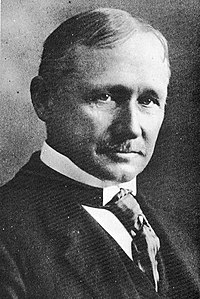
(iii)               Taylorism – Frederick Winslow Taylor was convinced that he could find the “one best way” to accomplish any job. Taylor himself came from an upper middle class background, but he became a machinist. “Soldiering” and what he perceived as inefficiencies of his fellow workers led him to develop time and motion studies, and to outline management practices devoted to prodding workers to put in 60-minute hours at work.

(b)   Technology – this drive for greater levels of productivity also led American industrialists to use more machines than capitalists in other countries

(i)                  Lack of skilled workers? – Some historians and economists have argued in the past that because the United States allegedly lacked skilled workers, that industrialists relied more on the development of machines and machine tools to compensate. Today this reliance seems to have come about for other reasons

(ii)                Labor costs – the increased level of machine use helped capitalists keep down the cost of labor, because the capitalist was able to replace skilled workers (who would have cost him more) with unskilled workers to tend the machines (who cost much less, and were easily replaced should they become recalcitrant.

(iii)               This also undermined the position of the union worker, obviously, especially the skilled worker, who made up most of the ranks of the unions belonging to the AFL. Union members within the AFL umbrella fight battles to retain the benefits of the knowledge they had gained from working a particular job.

(i)      “Featherbedding” – some AFL unions were successful for a time in keeping workers whose jobs had become technologically obsolete.

(c)    Profits – by the early 1890s, the Carnegie Steel Company was making profits of more than $40,000,000 a year

3)      Amalgamated Association of Iron, Steel, and Tin Workers (AA) – in 1892, the AA was the largest and strongest union within the AFL, with approximately 24,000 members. The members of the union included only the skilled workers in iron, steel, and tin foundries; not considered for membership was a much larger contingent of unskilled workers, many of whom were new immigrants from Eastern Europe.

B)     Homestead and the strike

1)      City of Homestead – named after the nearby iron mill, Homestead was located several miles from Pittsburgh, up the Monongahela River. The town was completely dominated by the Carnegie mill—but the town leaders and townspeople identified with the workers more than Carnegie or his managers.

2)      Homestead works – Ford C. Frick was hired by Carnegie to rid Homestead of the AA. After putting Frick in charge, Carnegie left for an extended stay in his castle in Scotland, but communicated in secret with Frick.

(a)    “Negotiations” – Frick made demands upon the AA which he knew would be unacceptable, and then locked out union members when negotiations broke down in late   June. Before the lockout, Frick had an eight-foot steel fence erected around the entire works

(b)   Pinkertons – on July 6, a bargeful of 300 Pinkerton agents was discovered motoring up the Monongahela by union lookouts, who quickly notified union members in Homestead. Union members quickly occupied the Homestead works, and a fierce gun battle raged along the riverfront for most of the day, when finally the Pinkerton agents were forced to surrender; agents were forced to run a gauntlet in town, and many were severely injured as a result

(c)    Won the battle, lost the war – the Allegheny sheriff was unable to recruit locals to “establish order,” and appealed to the governor for mobilization of the militia, and eight thousand troops arrived shortly to protect strikebreakers

(i)                  The Carnegie Company had the strike and union leaders arrested, some of who were charged with murder; after trials, all were found not guilty, but the defense efforts depleted the union treasury

The strike was conceded on November 20, 1892, and immediately the Carnegie Company lowered wages and increased the hours of its workers. The strike ended the influence of the AA.
III. 1894 Pullman Strike.

A.  George Pullman – made his fortune hauling Chicago out of the muck; after the Great Fire of 1871, efforts were made to raise the remaining buildings as much of the swamp that the city was built on was filled. Pullman used this money to establish a company to build sleeping cars used on long trips by railroad companies.

B. Town of Pullman – as the company grew, Pullman became concerned about the effect the radicals in Chicago were having upon his workers, so several miles south of the city he built a town (housing, stores, public buildings, a hotel he named after his daughter Florence, even churches) which he rented to workers, but which he retained title.

1) “Model” town – Pullman the town was a great example of welfare capitalism—that is, subsidizing certain amenities for workers so they remain satisfied on the job.

2) Depression of 1893 – the economic depression of 1893 cut deeply into the profits of the Pullman Company, and Pullman responded by cutting wages and laying off workers, as any good capitalist would do.

(a) Pullman rents – Pullman refused to cut rents in the same manner, however, since that division of the business had to show a profit as well.

(b) Pullman workers respond by going on strike in the spring of 1894.

C. Eugene V. Debs – a former officer of the Brotherhood of Railway Firemen, Debs in early 1894 became president of an early industrial union for railway workers, the American Railway Union.

1) Railway “Brotherhoods” – each specialty in the railroad industry had its own union, The Brotherhood of Railway Engineers, Brakemen, Conductors, Firemen; problems arose when railway companies settled with one of the brotherhoods, and they crossed the picket line while others were still on strike. The ARU is meant to be a solution to this problem.

2) 1894 ARU convention – was held in Chicago; a delegation of workers from Pullman, who plead for the assistance of the ARU. Despite Debs opposition, convention delegates vote to assist Pullman workers, and vote to boycott all trains with Pullman cars. Despite the fact that the ARU represents a relatively small number of workers, traffic all over the country is interrupted.

3) Government response – because there was little violence accompanying the strike the federal government was hamstrung; with a sympathetic John Peter Altgeld as Illinois governor, there was little chance that federal aid would be requested.

(a) Richard Olney – the AG for the federal government was a railroad attorney, and it was he who suggested attaching Pullman cars to mail trains (interfering with the mail is, of course, a federal offense).

(b) Troops from Fort Sheridan (and the Dakotas) are called in “to keep the peace,” which allowed the strike to be broken.

(c) Debs and other union leaders were arrested and held incommunicado, which also helped break the strike; Debs spent a year in jail in Woodstock, Illinois, which he spent reading socialist tracts; he becomes the Socialist Party candidate for president in 1900, 1904, 1908, and 1912, when he polled the largest number of votes to that time in history for a third party candidate.

Sunday, September 29, 2013

Working People Respond to Nationalizing Capital During the Civil War


I.               The Process of Industrial Capitalism
The Sunken Road at Antietam. Photo courtesy of Wikipedia Commons


A.   The Civil War—the Civil War is often called the first modern war, in large part because the decisive factor in the Union’s victory over the Confederacy was its industrial edge, which allowed the North to replace war material rapidly, while the South was slowly starved of war material.

1.     Financing the war—while part of the war was financed by simply printing more money, and another significant portion financed through the first income tax—but the war was also financed by the sale of bonds to investors. This created a growing role for bankers and financiers during the war, a position they were able to maintain when the war ended.
Jay Gould. Photo courtesy of Wikipedia Commons.

2.     Economic Class and the War—while we would like to think that American men would gladly fight for their country when called upon, this was not always the case. Early in the war, there were more volunteers on both sides than could actually get outfitted and trained adequately, by the second year of the war enlistments dropped precipitously for both the North and the South. This led to the institution of the first Conscription Acts (significantly, first by the alleged “states rights” proponents of the Confederacy) in American history.
Map of New York City Draft Riots


a.     Bonuses—because bonuses were also provided for soldiers who volunteered for service, a not uncommon practice for a number of men was to volunteer, collect the bonus for volunteer, and then desert—only to show up at a recruiting station to volunteer again.
Theodore Roosevelt, Sr. Photo courtesy of Wikipedia Commons


b.     Substitutes—both sides allowed draftees to provide substitutes, or to pay a bounty of $300.00 (the average yearly income of a worker at that time) to avoid service (the father of Theodore Roosevelt, for instance, chose to pay a bounty to the government instead of serving when he was drafted). This was seen as inequitable by many men at the time, and was a contributing factor for the New York City Draft Riot in July 1863.

c.     “Rich Man’s War and a Poor Man’s Fight”—because of this class bias, the Civil War was known at the time as “A Rich Man’s War, and a Poor Man’s Fight” because, while rich men often became richer supplying the armies with war material (see below),  poor men made up most of the foot soldiers, and also made up the lion’s share of dead bodies that were found on the battlefields.

3.     The Labor of Slaves in the War—the South had a much smaller population to draw upon to put soldiers in the field, and it was this population difference that was probably the greatest contributor to the defeat of the region in the Civil War. Over 40% of the population in the South in 1860 was African American (1.5% free blacks, and the rest slaves), and were never provided arms in any significant numbers (near the end of the war, there was much talk about arming slaves, and a few were allowed to serve in the Confederate Army—but not in significant numbers). This did allow the South to field a higher percentage of white men in its army than the North could muster—but not enough to make any real difference in the numerical superiority the North enjoyed.
Slave "contrabands"


a.     Continuation of slavery—until the appearance of the Union Army in the vicinity, most slaves in the South were little effected by the war. They continued to work on plantations and small farms, as well as in cities.

b.     The Great Strike—given the opportunity, however, slaves showed in great numbers that they were willing to help overthrow this system by showing up in Union Army encampments in huge numbers. “Contrabands,” as they were called, were initially returned when masters came to claim them, but after realizing that the domestic war effort in the South depended upon their labor, they were instead put to work in Union camps, until early 1863 when they were permitted to enlist in separate units in the Union Army. By the end of the war, African American troops made up approximately 10% of soldiers in the Union Army.

4.     Government Contracts—to provide clothing, bedding, tents, boots, wagons and horses, food, ammunition, weapons—in short, everything needed to run the war. It is easier for the government to maintain these contracts if they were given only to a few large business, rather than numerous small ones.

a.     Financiers—The Civil War was financed by a variety of means: printing more money (in fact, the so-called “greenbacks” were issued for the first time during this conflict—what we today identify as money), by raising taxes, and by selling bonds. The sale of bonds—promissary notes issued by the government to pay back the loan of money with interest—were a way for the government to raise money by financing the debt it was incurring to fight the war. The men selling these bonds received favorable discounts to encourage their promotion, and many made considerable profits from these sales.
Railroad mortar


5.     Transportation—Much of the South had relied upon river transportation, and resisted using government incentives to spur railroad growth; this obstacle was removed with secession and the withdrawal of much of the Southern Democratic contingent. The resultant spurt in rail line construction was spurred not only by the need to transport military goods, but also by the construction of the transcontinental rail line.

6.     Labor shortage—with numerous volunteers (and, later, conscripts) off fighting to save the Union, coupled with the growing demand for labor that the build-up for war entailed, the resultant labor shortage was very beneficial for those workers who were not called to service, since business owners could not abide a long work stoppage.
William Sylvis. Photo courtesy of Wikipedia Commons

B.    William Sylvis and the National Labor Union (NLU)
1.     Formed in 1866—While declaring practical objectives, like raising wages and improving working conditions, the NLU also promoted a political agenda, including the eventual establishment of a labor party.

2.     William Sylvis—born in Annolph, Pennsylvania in 1828, Sylvis began serving an apprenticeship as an iron molder by the early 1840. By the second half of that decade, he had finished that process, and worked in a variety of establishments in the Philadelphia area. During this time, Sylvis also began his association with the Stove and Hollow Core Molder’s Union, first as an organizer, and later, fulfilling a vision to bring all iron molders into a single union, at the head of the Iron Molders’ Union.
a.     Effects of the Civil War
b.     Manufacturers’ Associations
c.     The turn towards politics
d.     1868
e.     Sylvis’ death

C.    The NLU and Social Reform
1.     The 8 Hour Day—this proposal captures the imagination of workers for decades after it was first proposed by the NLU in 1866—to its final fruition in 1937.
2.     Cooperatives

Sunday, September 22, 2013

Industrial Capitalism in Antebellum America


Rather than merely rely on my interpretation for the development of capitalism in Antebellum American (meaning before the American Civil War), we'll start off this presentation by listening to a lecture from someone a bit more sympathetic to these developments, professor Donald Miller (no relation): http://www.learner.org/biographyofamerica/prog07/transcript/index.html


I. Division of Labor and the Factory

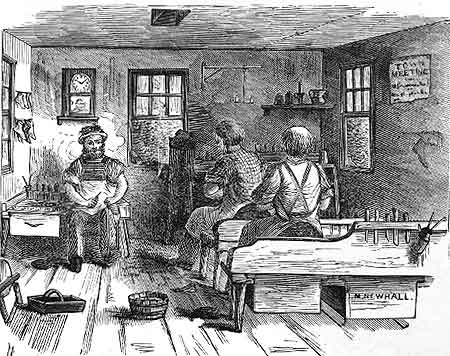
A. Outwork--the manufacture of some goods took place in the Early National period not in factories, but in the home, or in home-based shops.

1. Shoe Manufacturing in Lynn, Massachusetts--outwork began with the recruitment of workers from the countryside. Entreprenuers hired skilled craftspeople to cut leather hides into usable shapes (called "blanks"), and then recruited farmers and their families to sew the soles together, and attach the uppers to the sole. The market for "ready-made" shoes was largely the slave labor force in the South.

B. Factories--factories grew from established small shops, as master craftsmen ("masters") expanded their operations. As these larger shops became economically successful, they attracted other investors who new nothing about the manufacture of goods--but much about squeezing greater profits from a business.

1. Porkopolis--in the 1830s Cincinnati merchants built large slaughterhouses that slaughtered thousands of hogs every month. This was accomplished by developing a system of overhead rails that eased transportation of the hog carcasses around from station to station (the predecessor of the assembly line), dividing the slaughtering process into a number of discrete steps.

2. Textile manufacturing--

a. Great Britain--was the leading manufacturing nation in the world, largely on the strenght of its textile industry. To keep this position, economic and political leaders worked together to attempt to prevent the immigration of mechanics who held much of the manufacturing knowledge--especially the manufacture of machine tools.

i. "Free trade"--because of the manufacturing advantage Great Britain held over much of the rest of the world, British politicians became the strongest proponenets of the idea of "free trade"--of lowering trade barriers so the British could export their inexpensive manufactured goods.

ii. "Protectionism"--countries, including the United States, responded to this competition be "protecting" their own nascent industries by imposing tariffs (taxes on imported goods). These tariffs made imported goods more expensive, but also helped to protect and promote manufacturing--and therefore manufacturing jobs--in the host country.

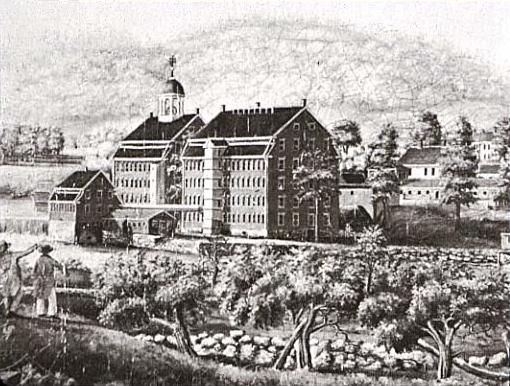
b. United States--the earliest textile factory in the United States was located in Pawtucket, Rhode Island (near Providence) at the falls of the Blackstone River. The falls powered the water wheel that, through a series of belts and pulleys, provided power to the machinery in the factory.

i. Finding workers--initially, workers at the Slater Mill in Pawtucket were recruited as family units. Fathers were expected to enforce factory discipline. This workforce, however, was largely resistant to the implementation of this factory discipline, taking days off to fish or hunt, and fathers often failed to discipline their offspring for their actions at work. By the 1820s, families were replaced by young, unmarried women from surrounding farms, who looked to work in factories as an escape from the drudge work on these family farms. This was first implemented at a mill in Waltham, Mass., and became known as the "Waltham Plan."

C. American Mechanics and Technological Innovation

1. Mechanic--today, we use the term "mechanic" to refer mainly to someone who works on automobiles; in the early 19th century, however, a mechanic was a highly-skilled mechanical generalist, able to build machine tools (machines used to make other machines); to be called a mechanic was very high praise,

2. Eli Whitney--was one of the premier mechanics in the Early National era. Whitney's mechanical genius led not only to the invention of the cotton gin, but also to the development of precision machine tools and interchangeable part. Whitney and a partner manufactured manufactured military weapons, and Whitney designed and built machines tools that could rapidly produce interchangeable musket parts. Being able to manufacture interchangeable parts was a huge leap forward in developing the manufacturing process, because the modern factory could not operate without it.

D. Wage workers and the Labor Movement--from early to the mid-19th century, many American craft workers espoused artisan republicanism, an ideology based on liberty and equality. They saw themselves as a group of small-scale producers, equal to one another and free to work for themselves.

1. Formation of unions--with the development of the outwork and factory system, more workers were becoming dependent upon wages, and less likely to become a small-scale producer (although this myth lived on for decades after this time). To assert their independence, workers rejected the term "master" and began using the Dutch work "boss" (which means master) instead. At about the same time, these workers also rejected the term "servant" for themselves, and instead became "hands" or "hired hands."

a. Workers with skills not easily transferred to machines--stone masons and members of other building trades were the most prominent examples--were able to retain a great deal of independence. Other workers, like shoemakers, hatters, printers, furniture makers, and weavers, saw their skills undermined by outwork and the introduction of machines--and as a result their status fell.

2. Labor ideology--with the formation of early labor unions, there also developed an ideology to support these unions: producerism and the labor theory of value.

a. Labor theory of value--held that the price for a particular good should be determined by the amount of labor required to produce it--and that the worker should get the lion's share of the profit, rather than the owner of the factory, who did nothing to add value to products. Although this idea was popularized by Karl Marx (who appropriated the idea from an English philosopher/economist named David Riccardo), but the idea first gained hold in early 19th century America.

II.             Canals – canals made the inexpensive transportation of raw materials from the hinterland to the city, and finished materials from the city to the hinterland, possible, which created markets both for farmers in these hinterlands (and encouraged them to begin to grow more to satisfy the market, rather than for their own subsistence) and for merchants in the cities (which also increased demand for inexpensive manufactured goods, which encouraged the construction and implementation of factories.

A.   Erie Canal – the construction of the Erie Canal ensured that New York City would remain the commercial center of the United States; its success spurred the construction of canals all over the country in the first half of the 19th century.

1.    Construction costs – although calls for the federal government to finance construction of the canal, in the end the state had to finance the project.  It did so by selling bonds to citizens, most of which was sold initially in relatively small increments ($1000-$2000); eventually the bonds were sold on the London Stock Market, and as far away as China, but the initial construction was financed by small investors within the state.

2.    Local contractors – were responsible for constructing specific portions of the canal; most had little experience in constructing something like this project, and were forced to learn on the fly; the profession of civil engineering was in fact invented on this project in the United States


3.    First section of canal opened in 1818 – the state of New York built the easiest section of the canal first, to assure success so that more investors would be encouraged to invest money.  This strategy worked; by 1824 the canal bonds were being traded on the London Stock Exchange.

4.    Expansion of markets for New York City – with the opening of the entire canal system, from Albany to Buffalo, then by the Hudson River to New York City in 1826, the market area for New York City became the entire Great Lakes area; raw materials (or near raw materials) where sent to NYC where they were finished into manufactured goods; these goods were then sent back into the hinterlands, or sent to Europe in exchange for European finished goods, which would be shipped to far-flung areas in the market area.


B.    Spur for the construction of other canals – the huge success of the Erie Canal spurred the construction of a large number of other canals.

1.    Pennsylvania Main Line – to connect Philadelphia to the coalfields in the Allegheny Mountains; the engineering problems that they had to be overcome for that the canal took much longer to become profitable.

2.    Baltimore and Ohio – to connect Baltimore to the Ohio River; again the construction costs to build the canal through the Allegheny Mountains prevented the canal from becoming quickly profitable.
3.    Canals in the Midwest

a.    Ohio and Erie – connected Cleveland to the Ohio River at Portsmouth

b.    Wabash and Erie – to connect western Indiana with a Lake Erie port at the Maumee River; Indiana granted land in northwestern Ohio to accomplish this, which the state of Ohio protests.  Eventually becomes two separate canal projects—the Wabash and Erie, and the Miami and Erie canal; the Miami and Erie eventually extends from Cincinnati northward to a city formerly thought to be at the southern boundary of the then territory of Michigan.

c.    Illinois and Michigan Canal – this canal connected a backwater village near the southern shore of Lake Michigan, which had taken its name from the native word for the smell of rotting onions that grew in the swamps in its midst (Chee-caw-go), to the Illinois River, and then southward to the Mississippi River.  This city finds its greatest growth in the second transportation wave, the railroad.

C.   End of the Canal Era – by the 1840s, the greatest era of canal building had ended; none of the canals built during the era were as successful as the Erie Canal; in fact, several states that had built several canals during this time period—namely, Ohio and Illinois—teetered on the edge of bankruptcy as a result.
1.    Capitalization costs – the construction of canals were capital intensive; digging miles of canal, even by cheaply employed immigrant labor, cost a lot of money; upkeep on the canals, once dug, was an added expense.
2.    Technology superceded – the improvements made in the construction of steam engines, which made possible the railroad locomotive, made the canal obsolete.
a.    Railroads – able to move freight year round; canal could only be used during the non-winter months, since they were dependent upon water; railroad also prove to be faster, and able to transport more material in a single load.  Toledo, in fact, was the terminus of a railroad before its canal era began (the Toledo and Adrian railroad, which began operating in 1837)